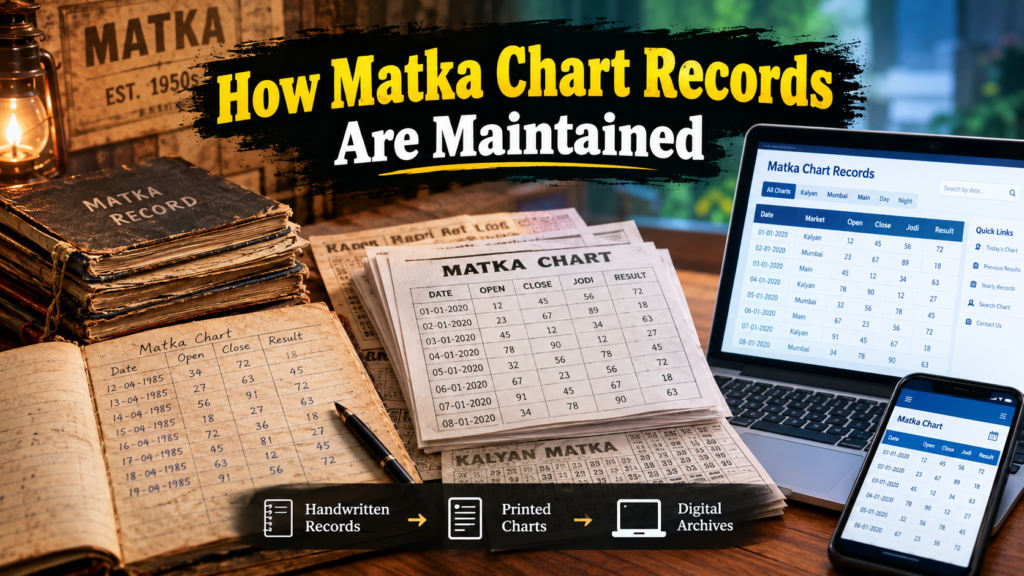
Matka charts have played an important role in documenting the history of number-based betting in India. Long before digital platforms became common, results and previous records were usually maintained through handwritten notes, printed tables, notebooks, and local records. Today, chart records can be presented in digital formats, making historical information easier to organize and review.
Understanding how a matka chart record is maintained also provides useful insight into how traditional number records have evolved from informal paper-based systems to modern online databases.
What Is a Matka Chart?
A Matka chart is essentially a structured record of numbers associated with different dates, markets, or sessions. Depending on the particular format, a chart may contain dates, opening and closing figures, historical results, and other numerical information.
Traditionally, these records were maintained by individuals or local operators who needed a consistent way to document previous outcomes. Keeping organized records made it possible to look back at earlier results without relying entirely on memory or scattered handwritten notes.
Over time, the chart became an important reference for people interested in the history and terminology surrounding Matka.
Traditional Methods of Maintaining Records
In the early days, records were primarily kept on paper. Small notebooks, registers, loose sheets, and printed charts were commonly used to write down numerical outcomes.
Because these records were often created manually, accuracy depended heavily on careful writing and verification. A single incorrectly written digit could create confusion later. For this reason, some record keepers maintained duplicate copies or checked numbers against another source before updating their main chart.
Paper records also required physical storage. Older notebooks could become damaged because of moisture, dust, frequent handling, or simple wear and tear. Despite these limitations, handwritten records formed an important part of the historical development of Matka charts.
The Development of Printed Charts
As interest in Matka increased, printed charts became more common. Instead of writing every result manually, publishers and local distributors could produce tables covering multiple dates.
Printed charts offered several advantages. They were easier to read, could cover longer periods, and provided a standardized structure for presenting information. A historical chart might contain several weeks or months of records in a single document.
This development also helped create a more recognizable format for displaying past numbers. Different publishers could use their own layouts, but the basic purpose remained similar: organizing historical numerical information in a convenient form.
Digital Record Keeping
The internet introduced another major change. Historical chart information could be transferred from paper records into spreadsheets, databases, and websites.
Digital records are generally easier to organize and search. A website can categorize information by date, market, year, or other criteria, allowing users to locate older entries more efficiently than with a physical notebook.
Digital storage can also make it easier to maintain large archives. Instead of keeping hundreds of pages in physical files, a website or database can store large quantities of historical information electronically.
However, digital records still depend on the quality of the original information. If an entry is copied incorrectly, the error can become part of the online archive. Good record-keeping therefore requires attention to data entry, verification, and consistency.
Why Historical Chart Records Matter
Historical chart records can be useful for researchers, writers, and people interested in understanding the cultural history of number-based betting in India. They show how record-keeping practices have changed over several decades.
Some online resources organize historical information into accessible tables and archives. For readers looking for background information and organized matka chart record resources, such databases can make older numerical information easier to explore.
It is important to distinguish historical records from claims that past numbers can reliably predict future outcomes. Previous results are historical data and do not guarantee future results.
Accuracy and Verification
Maintaining a reliable chart requires consistent methods. Important practices include checking dates, avoiding duplicate entries, correcting obvious transcription mistakes, and preserving older records rather than replacing them without documentation.
Digital publishers can further improve reliability by maintaining backups and tracking updates. A clearly organized archive should make it possible to understand when information was added or corrected.
The Future of Matka Chart Records
The transition from handwritten registers to searchable online archives demonstrates how technology has transformed historical record keeping. Modern databases can organize years of information in ways that were difficult to achieve with physical documents.
As digital publishing continues to develop, chart records may become increasingly structured, searchable, and accessible. At the same time, preserving older documents remains valuable because they provide historical context that may otherwise be lost.
Ultimately, the maintenance of Matka chart records is a story of changing technology and information management. From handwritten notebooks to modern digital archives, the goal has remained largely the same: to preserve numerical records in an organized format that can be referenced over time.